
Your shopping cart is empty.
16
Workers complete a hearing test, record the test results, and repeat the process at regular intervals.
Without a baseline, those results have limited value.
A baseline audiogram gives organisations a clear reference point. It allows them to compare future test results and identify changes in hearing thresholds over time.
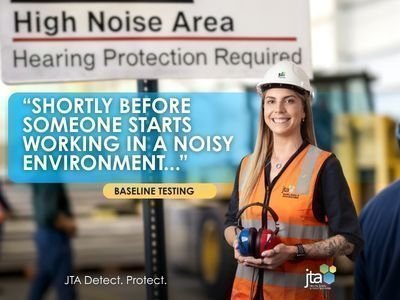
A baseline audiogram is the initial hearing test completed before or shortly after someone starts working in a noisy environment.
It establishes a record of a worker’s hearing levels and hearing thresholds at a specific point in time.
Organisations use this baseline to:
Without this reference point, organisations cannot reliably determine whether occupational noise has affected hearing.
A baseline audiogram plays a critical role in both compliance and risk management.
It enables organisations to:
From a compliance perspective, a baseline provides essential evidence if hearing loss is later identified.
Organisations must conduct baseline audiometric testing when workers face exposure to occupational noise at hazardous levels.
In Australia, this typically applies when noise levels reach or exceed:
Organisations should complete baseline testing:
This ensures accurate and meaningful comparisons of test results over time.
Baseline audiograms form the foundation of an effective hearing monitoring program.
Follow-up audiometric testing allows organisations to track changes in hearing thresholds and identify trends across roles or teams.
As JTA consultant Serena Foote explains:
“A baseline audiogram is an initial hearing test completed before or shortly after someone starts working in a noisy environment. It establishes a reference point for their hearing levels.
We then conduct follow-up testing, typically within two years, and compare those results to the baseline to identify any significant changes.
If a shift in hearing is detected, further investigation may be required. This can include reviewing workplace noise levels, assessing hearing protection, or conducting a noise assessment. Where necessary, employees may also be referred to an audiologist for further testing.”
This approach allows organisations to detect threshold shifts early and link them back to workplace exposure where required.
A key purpose of baseline audiometric testing is to identify significant threshold shifts.
A threshold shift occurs when a worker’s hearing threshold changes compared to their baseline audiogram. This means sounds must be louder for the worker to detect them.
In practical terms, a significant threshold shift may indicate:
When organisations detect a shift, they should take action to understand the cause and prevent further deterioration.
This may include:
Identifying threshold shifts early allows organisations to intervene before hearing loss becomes permanent.
A baseline audiogram does not operate in isolation.
It forms part of a broader approach to managing risks associated with occupational noise.
When audiometric testing identifies changes in hearing thresholds, organisations must investigate the underlying cause.
This is where workplace noise assessments play a critical role.
By assessing workplace noise levels, organisations can:
This connection between hearing test results and workplace conditions ensures that organisations move beyond monitoring and take practical steps to prevent further harm.
Without a baseline audiogram, organisations lose critical context.
They cannot:
This gap increases both operational risk and potential liability.
At JTA, we deliver audiometric testing as part of a structured approach to managing noise risk.
This approach aligns with our broader methodology of identifying, assessing, and controlling workplace hazards over time.
We conduct baseline and ongoing audiometric testing using calibrated equipment in accordance with relevant standards.
We analyse test results against baseline data to identify significant threshold shifts and potential risk.
Where risks are identified, we provide practical guidance on next steps, including further assessment, control measures, and hearing protection strategies.
We support ongoing monitoring programs, ensuring that testing remains aligned with workplace conditions and regulatory requirements.
This ensures that organisations actively manage hearing risks rather than reacting to them.
A baseline audiogram does more than establish a starting point.
It gives organisations the ability to:
Without a baseline, hearing data lacks context.
With it, organisations gain clarity, control, and confidence in their compliance approach.
Detect. Protect.
Get a Quote/Book Online
OR
Call Us on 1300 856 282
References
1 https://www.pnas.org/content/118/17/e2018995118






Head Office Melboune
139 Ormond Road Elwood, VIC 3184
Mornington Peninsula
20 Lister Avenue,
Sorrento,
VIC 3943
JTA Health, Safety & Noise Specialists acknowledges the Boon Wurrung People of the Kulin Nation as the Traditional Owners and Custodians of the land on which the home of JTA resides. We pay our respects to their Elders past, present and emerging, and acknowledge and uphold their continuing relationship to this land.