
Your shopping cart is empty.
16
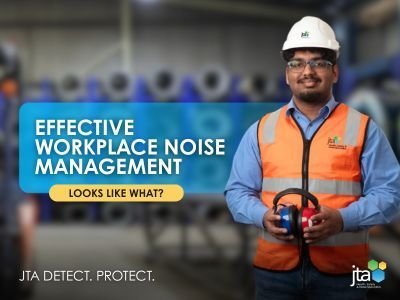
In earlier articles in this series, we looked at why workplace noise is prominent on the regulatory radar. We also covered situations that often catch organisations out.
The next question is straightforward.
What does effective workplace noise management actually look like in practice?
For many organisations the challenge is not recognising that noise exists. The challenge is translating noise exposure data into practical action that protects workers and meets WHS obligations.
At JTA we approach this through a structured process built around our Detect. Protect. model.

When implemented properly this process helps organisations move from reactive compliance to proactive risk management.
The first step in effective workplace noise management is identifying where hazardous exposure may occur.
Noise risks are not always obvious. Many workplaces contain multiple noise sources that combine to create higher noise levels than expected.
Rather than guessing which activities are loud, structured assessments begin by identifying Similar Exposure Groups (SEGs). These groups consist of workers performing similar tasks or operating in similar environments.
Workers who face frequent noise exposure often know which tasks are loudest. Consultation with supervisors and the health and safety representative can help identify areas where exposure is most likely.
By analysing tasks, equipment and work areas, organisations can prioritise monitoring before measurements begin.
This targeted approach ensures monitoring focuses on the real source of the noise rather than assumptions.
After you identify potential risk areas, you must measure exposure accurately through a structured noise assessment.
Noise monitoring typically involves a combination of area monitoring and personal dosimetry.
Area monitoring measures sound pressure levels at specific workstations or operator positions. Personal dosimetry measures a worker’s exposure across a full shift.
A competent person conducts these measurements according to recognised standards such as AS/NZS 1269.1, allowing them to compare the results against the national exposure standard of 85 decibels averaged over an eight-hour workday.
Measurements often reveal patterns that are not obvious during normal operations.
For example:
• intermittent equipment producing high peak noise levels
• multiple machines contributing to cumulative exposure
• tasks where workers are exposed to noise for longer periods than expected
Visual outputs like noise exposure heat maps help organisations see where exposure is highest. They also show where it may be necessary to restrict access to noisy areas.
When you identify risks, you can use a detailed noise assessment to confirm whether workers exceed the exposure standard.
Collecting exposure data alone does not reduce risk.
Once organisations understand the level of risk, they must implement practical control measures.
The best noise management strategies reduce noise at the source whenever possible. They use engineering controls like quieter equipment, isolation barriers, or equipment enclosures.
Other control measures may include:
• administrative controls that reduce exposure time
• isolating high noise processes
• redesigning workflows to minimise exposure
Providing personal protective equipment, including suitable hearing protectors, may also be necessary where other controls cannot fully eliminate exposure.
However, you should view hearing protection as one layer of protection within a broader control strategy.
One of the most powerful steps in workplace noise management is connecting noise exposure data with audiometric testing results.
Noise monitoring provides exposure information. Audiometric testing helps identify early changes in hearing that may indicate a risk of hearing loss.
When organisations review these two sources of information together, they can answer an important question.
Are current control measures actually protecting workers?
If monitoring shows workers regularly experience noise near the exposure standard and audiometric testing identifies hearing threshold shifts, this may indicate a growing risk of noise related injury.
Without review, long term exposure may eventually lead to noise induced hearing loss or even permanent hearing loss.
Linking exposure data with hearing outcomes helps organisations verify whether their controls are effective.
Effective workplace noise management also depends on worker understanding.
Workers need to understand why they must wear hearing protection and how to recognise hazardous noise.
Training may include:
• toolbox talks explaining noise hazards and exposure limits
• instruction on when and how to use hearing protectors
• explaining areas where workers may be exposed to noise
• reinforcing the correct use of personal protective equipment
When workers understand the reason behind controls, compliance improves significantly.
Workplace noise management should always be treated as an ongoing process rather than a one time exercise.
Workplaces change. Someone replaces the equipment. Production levels increase.
Regular review helps ensure:
• exposure data reflects current noise levels
• control measures remain effective
• hearing protection remains suitable
• noise sources introduced by new equipment are assessed
Without periodic reassessment, the risk of hearing loss can increase as workplace conditions change.
Organisations that address noise risks early often avoid larger problems later.
Early intervention allows employers to reduce exposure before workers suffer noise induced hearing loss or permanent hearing loss.
In practice, audiometric testing and noise exposure monitoring are most effective when used together.
Testing identifies early warning signs. Exposure monitoring identifies the source of the noise and the control measures needed to manage it.
Across this series we have explored three important questions.
Why workplace noise remains a significant occupational risk.
Where organisations are commonly falling short.
What effective workplace noise management looks like in practice.
For most organisations improving noise management does not require starting again from the beginning. It requires ensuring existing systems are active, current and supported by reliable data.
If you have not reviewed workplace noise in the past 12 to 24 months, you can often start most efficiently by reviewing noise exposure monitoring and audiometric testing together.
Detect. Protect.
If you would like to discuss workplace noise at your site, call 1300 856 282 or reply to this email.
Get a Quote/Book Online
OR
Call Us on 1300 856 282
References
1 https://www.pnas.org/content/118/17/e2018995118






Head Office Melboune
139 Ormond Road Elwood, VIC 3184
Mornington Peninsula
20 Lister Avenue,
Sorrento,
VIC 3943
JTA Health, Safety & Noise Specialists acknowledges the Boon Wurrung People of the Kulin Nation as the Traditional Owners and Custodians of the land on which the home of JTA resides. We pay our respects to their Elders past, present and emerging, and acknowledge and uphold their continuing relationship to this land.