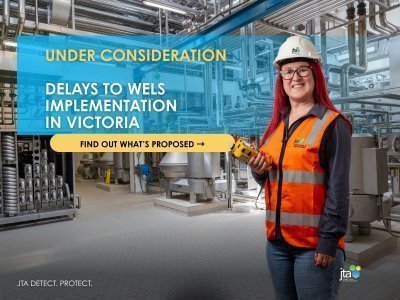
Victoria is considering different transition arrangements for 15 Workplace Exposure Limits (WELs), including staged limits for diesel particulate matter. The broader change from Workplace Exposure Standards (WES) to WELs remains scheduled for 1 December 2026.
For national businesses, the next step is a coordinated plan that checks the requirements and exposure-control gaps at each site.
What is changing and what remains under consideration
NATIONAL TRANSITION: STILL SCHEDULED
1 December 2026
WES terminology changes to WELs.
The nine contaminants listed below retain their current numerical levels as WELs.
NTGCs have no assigned numerical WEL; exposure must still be controlled.
Continue preparing for the applicable 2026 changes. Check jurisdictional implementation for each workplace.
VICTORIA: UNDER CONSIDERATION
Proposed transition to 1 December 2029
Different arrangements for the 15 contaminants below.
A proposed delay to 2029 for 14 contaminants.
Separate proposed diesel limits from 2026, with a further reduction in 2029 for industries outside underground mining.
No delay confirmed in the update.
Compare the proposed changes by contaminant
Select a contaminant to expand its current WES, published national WEL and proposed Victorian arrangements. Each comparison keeps the measurement basis, units and exposure period together. The Victorian proposals are not confirmed. For newly introduced limits, existing duties to control exposure still apply.
The WorkSafe Victoria update identifies the following contaminants for the proposed Victorian transition arrangements.
Showing all 15 contaminants. Every entry is under consideration.
Proposed Victorian arrangements: select a contaminant for the exposure-limit comparison
Contaminant
Proposed timing
Bitumen fumesUpdated exposure limit
Current exposure standard
8-hour TWA: 5 mg/m³ (inhalable). No separate STEL or peak limit.
New national exposure limit
8-hour TWA: 0.5 mg/m³ (inhalable). No separate STEL or peak limit.
What Victoria is considering
Victoria is considering a later start of 1 December 2029 for this change. No delay has been confirmed.
Timing
National transition: 1 December 2026, with requirements checked for each state or territory. Proposed Victorian start: 1 December 2029, if approved.
Other exposure risks to consider
Health monitoring may be required. Check the requirements that apply at your workplace.
Diesel particulate matter, measured as respirable elemental carbonNew exposure limit
Current exposure standard
New exposure limit. Diesel particulate matter has no specific limit under the current national WES. Existing exposure-control duties and any state or mining requirements still apply.
New national exposure limit
8-hour TWA: 0.01 mg/m³, as respirable elemental carbon. No separate STEL or peak limit.
What Victoria is considering
Victoria is considering 0.1 mg/m³ from 1 December 2026 for underground mining and all other industries, measured as respirable elemental carbon. For industries outside underground mining, a further reduction to 0.01 mg/m³ is proposed from 1 December 2029. No 2029 reduction is specified for underground mining. Neither stage is confirmed.
Timing
National transition: 1 December 2026, with requirements checked for each state or territory. Proposed Victorian stages: 1 December 2026, then 1 December 2029 for industries outside underground mining.
What this means for your workplace
The proposed Victorian values do not yet specify an averaging period. JTA can help check the final requirements, including any separate mining rules, before these figures are used in a workplace assessment.
Manganese fumeUpdated limits for two particle fractions
Current exposure standard
Manganese fume (as Mn): 8-hour TWA 1 mg/m³ (inhalable), with a 15-minute STEL of 3 mg/m³. Manganese dust and compounds (as Mn) have a separate 8-hour TWA of 1 mg/m³.
New national exposure limit
Manganese fume, dust and compounds (as Mn): 8-hour TWA 0.1 mg/m³ for the inhalable fraction and 0.02 mg/m³ for the respirable fraction. No separate STEL or peak limit.
What Victoria is considering
Victoria is considering a later start of 1 December 2029 for this change. No delay has been confirmed.
Timing
National transition: 1 December 2026, with requirements checked for each state or territory. Proposed Victorian start: 1 December 2029, if approved.
What this means for your workplace
The new limits cover two particle fractions, so the sampling method matters as well as the number. Victoria’s proposal names manganese fume; whether other manganese forms are included will need to be confirmed. JTA can help check which measurements and limits apply at your site.
Other exposure risks to consider
Manganese has an ototoxic notation, meaning it can affect hearing.
Nickel already has exposure standards. The current limit depends on the form of nickel present.
Nickel sulphide roasting fume and dust (as Ni): 8-hour TWA 1 mg/m³ (inhalable).
Nickel metal and nickel powder: 8-hour TWA 1 mg/m³.
Nickel dichloride, nickel dinitrate and nickel salt, nitric acid: each has an 8-hour TWA of 0.1 mg/m³.
Nickel soluble compounds (as Ni): 8-hour TWA 0.1 mg/m³.
New national exposure limit
Nickel metal and insoluble compounds (as Ni), including nickel sulphide roasting fume and dust: 8-hour TWA 0.1 mg/m³ (inhalable).
Nickel soluble compounds (as Ni): 8-hour TWA 0.1 mg/m³ (inhalable).
Neither group has a separate STEL or peak limit.
What Victoria is considering
Victoria is considering a later start of 1 December 2029 for this change. No delay has been confirmed.
Timing
National transition: 1 December 2026, with requirements checked for each state or territory. Proposed Victorian start: 1 December 2029, if approved.
What this means for your workplace
Some nickel limits are lower, while forms already at 0.1 mg/m³ remain at that level. Victoria’s proposal refers to nickel fume; the forms covered will need to be confirmed when the arrangements are finalised. JTA can help identify the nickel compounds present and the requirements for your workplace. Nickel carbonyl has separate requirements.
Other exposure risks to consider
Nickel compounds can present cancer and sensitisation risks. Check the safety data sheet for the specific material. Under the WEL guidance, metal and insoluble compounds carry a skin-sensitisation notation; soluble compounds carry skin- and respiratory-sensitisation notations. Health-monitoring and use restrictions may also apply under the relevant local rules.
8-hour TWA: 0.3 ppm (0.42 mg/m³). 15-minute STEL: 1 ppm (1.4 mg/m³). No separate peak limit.
New national exposure limit
8-hour TWA: 0.05 ppm (0.07 mg/m³) and peak limit 0.15 ppm (0.21 mg/m³). There is no separate 15-minute STEL.
What Victoria is considering
Victoria is considering a later start of 1 December 2029 for this change. No delay has been confirmed.
Timing
National transition: 1 December 2026, with requirements checked for each state or territory. Proposed Victorian start: 1 December 2029, if approved.
What this means for your workplace
The 8-hour average limit is lower, and a peak limit replaces the previous 15-minute STEL. The new 0.15 ppm value is a peak limit. Check the transition arrangements for each state or territory.
Portland cementUpdated limit and particle fraction
Current exposure standard
8-hour TWA: 10 mg/m³, inhalable dust containing no asbestos and less than 1% crystalline silica. No separate STEL or peak limit.
New national exposure limit
8-hour TWA: 1 mg/m³, respirable dust containing no asbestos and less than 1% crystalline silica. No separate STEL or peak limit.
What Victoria is considering
Victoria is considering a later start of 1 December 2029 for this change. No delay has been confirmed.
Timing
National transition: 1 December 2026, with requirements checked for each state or territory. Proposed Victorian start: 1 December 2029, if approved.
What this means for your workplace
The measurement changes from inhalable to respirable dust, so the two numbers cannot be compared directly. JTA can help review the sampling approach and assess silica or other components where relevant.
Certain hardwoods such as beech and oak: 8-hour TWA 1 mg/m³ (inhalable); no separate STEL.
Softwood: 8-hour TWA 5 mg/m³ (inhalable); 15-minute STEL 10 mg/m³.
New national exposure limit
Certain hardwood such as beech: 8-hour TWA 1 mg/m³ (inhalable); no separate STEL or peak limit.
Softwood: 8-hour TWA 2 mg/m³ (inhalable); no separate STEL or peak limit.
What Victoria is considering
Victoria is considering a later start of 1 December 2029 for this change. No delay has been confirmed.
Timing
National transition: 1 December 2026, with requirements checked for each state or territory. Proposed Victorian start: 1 December 2029, if approved.
What this means for your workplace
The hardwood average stays at 1 mg/m³. For softwood, the average falls from 5 to 2 mg/m³ and the separate STEL is removed. JTA can help identify the applicable requirements for the species and mixtures used at your workplace.
Other exposure risks to consider
The current guidance identifies sensitisation risks. The new guidance flags skin and respiratory sensitisation, as well as skin absorption.
No matching contaminants in this proposal. Try a different search or reset the filters. This table is not the complete WEL list.
The proposed diesel timeline
Proposed diesel limits differ by industry and are measured as respirable elemental carbon.
Proposed diesel particulate matter limits measured as respirable elemental carbon
Industry
From 1 December 2026
From 1 December 2029
Underground mining
Proposed: 0.1 mg/m³
No reduction to 0.01 mg/m³ is proposed in this update
All other industries
Proposed: 0.1 mg/m³
Proposed: 0.01 mg/m³
These diesel arrangements are also proposed. The update does not set a 2029 reduction to 0.01 mg/m³ for underground mining.
Nine contaminants will retain their current levels
These nine contaminants retain their current numerical exposure levels as WELs from 1 December 2026:
Benzene
Chlorine
Copper
Formaldehyde
Hydrogen cyanide
Hydrogen sulfide
Nitrogen dioxide
Respirable crystalline silica
Titanium dioxide
What does NTGC mean?
NTGC stands for non-threshold genotoxic carcinogen. These substances can damage genetic material and may cause cancer, with no safe exposure level established.
Their numerical exposure limits are being removed because no safe exposure limit can be established. Safe Work Australia’s NTGC guidance explains that they are identified separately in Appendix B of the WEL document.
Workplaces must eliminate exposure so far as is reasonably practicable. Where elimination is not reasonably practicable, exposure must be minimised to as low a level as is reasonably practicable, using the highest available controls in the hierarchy. Substitution, isolation and engineering controls should be considered before relying on administrative measures or personal protective equipment.
Detect. Protect. A practical plan for each workplace
For businesses operating across multiple states, changing exposure limits can complicate an existing rollout. JTA can help review your plan, identify site-specific gaps and coordinate practical improvements across your operations, while keeping worker protection and applicable deadlines at the centre.
Detect the gaps
Review the contaminants each site uses or generates, available exposure information and existing controls. Compare these against current obligations, confirmed upcoming requirements in that jurisdiction and the proposed Victorian 2029 scenario for planning purposes.
A useful gap-analysis matrix could record each site's contaminant, current requirement, applicable 2026 change, proposed 2029 scenario, evidence gap and action priority. Other states and territories need their own checks; a Victorian proposal should not be applied nationally.
Protect your people
Use the findings to develop a prioritised action plan: address current risks first, then schedule control improvements, monitoring and verification against applicable duties and confirmed deadlines. Give each action an owner, target date and a way to check it has worked.
This can help coordinate assessments and engineering projects around business operations while protecting teams. A phased plan must not postpone necessary protection or assume that a proposed 2029 date has been approved.
Practical WEL guidance for your industry
Explore JTA’s resources to help identify the exposure risks relevant to your operations and prepare your next steps.
Councils & LGAs: road maintenance, asphalt, depots, waste facilities and parks.
Discuss a WEL gap assessment with JTA
JTA is keeping across the changes. Talk to us about a gap assessment or a review of your existing plan, so you can coordinate practical improvements across your sites.