Your shopping cart is empty.
16
Managing exposure in Victoria? Read JTA’s detailed guide to Victoria’s 2026–2029 workplace exposure limits for the interim limits and Victorian work activities.
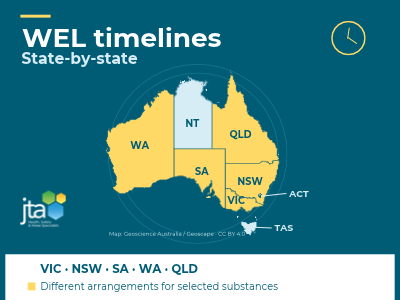
Safe Work Australia publishes the national WEL list, but the limits are implemented through Commonwealth, state and territory laws. Some jurisdictions have announced additional transition periods or interim limits for particular substances.
A later commencement date does not remove an employer’s existing duties to manage exposure risks or meet the limits that currently apply.
Most new WELs are due to apply from 1 December 2026. WorkSafe Victoria has published transition arrangements for 15 substances and substance groups, including flour dust, grain dust, phosphine, methyl bromide and diesel particulate matter (DPM).
For many of these, the transition runs until 1 December 2029. Diesel particulate matter has a staged approach: an interim limit applies from December 2026, with a lower limit planned from December 2029 for industries other than underground mining.
Victoria’s current regulations sunset before the transition ends. Remade OHS regulations are required from April 2028 to maintain the published arrangements through November 2029.
Read WorkSafe Victoria’s arrangements.
The general transition starts on 1 December 2026, with staged arrangements for phosphine and diesel particulate matter.
Existing phosphine limits continue until 30 June 2028. An interim diesel particulate matter limit applies from December 2026. Both transition to the national WELs on 1 July 2028.
For businesses using diesel equipment, that means there is still a December requirement to prepare for.
SafeWork SA has announced that the new WELs for flour dust, grain dust and methyl bromide will be delayed until no earlier than July 2028. A separate announcement defers the reduced phosphine limit until July 2028.
These announcements do not delay the whole WEL program. Businesses should still check the December requirements for their other contaminants.
Read SafeWork SA’s dust and fumigant update and phosphine update.
WorkSafe WA has deferred the reduced phosphine limit until 1 December 2029. For diesel particulate matter, it says a regulatory impact assessment will occur before any change to the exposure standard or limit. A replacement commencement date has not been confirmed in its published update.
Other December changes still need attention. Read WorkSafe WA’s update.
Most WELs apply from 1 December 2026. WorkSafe Queensland has confirmed transition arrangements for 15 substances and substance groups until 1 December 2029, including flour dust, grain dust, phosphine, methyl bromide and diesel particulate matter.
During the transition, diesel particulate matter has a TWA of 0.1 mg/m³ as respirable elemental carbon. Flour dust has no prescribed numerical exposure limit; the existing WES continues for the other 13 deferred substances. These arrangements do not defer every Queensland WEL. Duties to eliminate or minimise exposure remain.
These are general WHS arrangements. Queensland mines have separate exposure requirements; see the mining comparison and source notes below. Read WorkSafe Queensland’s confirmed arrangements.
Published guidance in Tasmania and the ACT, and the Northern Territory’s approved silica code, identify 1 December 2026 as the general transition date. Workplaces should also check any additional industry-specific requirements.
Businesses should not assume that an exception announced elsewhere applies in their jurisdiction.
A national decision announced in October sets 1 June 2027 for the benzene eight-hour limit to reduce from 1 ppm to 0.2 ppm, subject to local implementation. Eight other chemicals remain under further expert review. Read the Safe Work Australia update.
Matrix reviewed 5 November 2026.
JTA is tracking the changing timelines across Australia to help businesses understand what applies at each workplace. Use the matrix below to compare the arrangements for your state or territory and plan a consistent response across your operations.
Check the local requirements. National targets and announced dates do not replace local law. Read the interim limits, source notes and activity-specific caveats before applying a value.
Select a substance to compare its limits and timing across all eight jurisdictions. Dates show the published commencement or transition position; announced delays and current limits are stated directly. The source notes explain where the comparison relies on regulator guidance and where legal implementation needs confirmation.
General workplace rules are shown unless an industry is named. Queensland mines have separate exposure requirements.
TWA means eight-hour time-weighted average; STEL means short-term exposure limit. A peak limit must not be exceeded at any time. Diesel particulate matter is measured using the particle fraction and method specified in the applicable rules; REC means respirable elemental carbon. Values are not assurances of safety.
Queensland’s 15-substance transition runs until 1 December 2029; the rows identify the interim arrangements. Victoria’s published transition also extends to 2029; remade Victorian OHS regulations are required from April 2028 to maintain those arrangements. National decisions remain subject to applicable local law. Check the substance, particle fraction, work activity and current requirements before applying a value.
| Jurisdiction or comparison | Limit or timing |
|---|---|
| National target or comparison | New limit: 0.5 mg/m³ inhalable TWA |
| Victoria | 1 December 2029 — published transition |
| New South Wales | 1 December 2026 |
| South Australia | Delayed until at least July 2028 |
| Western Australia | 1 December 2026 |
| Queensland | 1 December 2029 — no prescribed numerical limit during the transition; exposure controls still required |
| Tasmania | 1 December 2026 |
| Australian Capital Territory | 1 December 2026 |
| Northern Territory | 1 December 2026 |
| Important notes | Flour dust is a new listing, distinct from grain dust. Existing risk-control duties continue. See the national values and source notes below. |
| Jurisdiction or comparison | Limit or timing |
|---|---|
| National target or comparison | 4 → 1.5 mg/m³ inhalable TWA |
| Victoria | 1 December 2029 — published transition |
| New South Wales | 1 December 2026 |
| South Australia | Delayed until at least July 2028 |
| Western Australia | 1 December 2026 |
| Queensland | 1 December 2029 — existing WES continues during the transition |
| Tasmania | 1 December 2026 |
| Australian Capital Territory | 1 December 2026 |
| Northern Territory | 1 December 2026 |
| Important notes | Grain and flour have different limits. South Australia’s announced deferral has no fixed final commencement date. |
| Jurisdiction or comparison | Limit or timing |
|---|---|
| National target or comparison | 5 → 1 ppm TWA; skin notation |
| Victoria | 1 December 2029 — published transition |
| New South Wales | 1 December 2026 |
| South Australia | Delayed until at least July 2028 |
| Western Australia | 1 December 2026 |
| Queensland | 1 December 2029 — existing WES continues during the transition |
| Tasmania | 1 December 2026 |
| Australian Capital Territory | 1 December 2026 |
| Northern Territory | 1 December 2026 |
| Important notes | Exposure limits, product-use approvals and fumigant clearance rules are separate requirements. |
| Jurisdiction or comparison | Limit or timing |
|---|---|
| National target or comparison | 0.3 → 0.05 ppm TWA; old STEL 1 → PEAK 0.15 ppm |
| Victoria | 1 December 2029 — published transition |
| New South Wales | 1 July 2028 — delayed start |
| South Australia | July 2028 — delayed start |
| Western Australia | 1 December 2029 — delayed start |
| Queensland | 1 December 2029 — existing WES continues during the transition |
| Tasmania | 1 December 2026 |
| Australian Capital Territory | 1 December 2026 |
| Northern Territory | 1 December 2026 |
| Important notes | Peak limits and STELs use different exposure periods. Phosphine product-label and clearance requirements also apply separately. |
| Jurisdiction or comparison | Limit or timing |
|---|---|
| National target or comparison | Target 0.01 mg/m³ TWA as respirable elemental carbon |
| Victoria | 0.1 mg/m³ from 1 December 2026; 0.01 mg/m³ from 1 December 2029 |
| New South Wales | 0.05 mg/m³ from 1 December 2026; 0.01 mg/m³ from 1 July 2028 |
| South Australia | 0.01 mg/m³ from 1 December 2026 |
| Western Australia | Change on hold pending impact assessment; no new date announced |
| Queensland | 0.1 mg/m³ TWA as respirable elemental carbon during the transition; 0.01 mg/m³ from 1 December 2029 |
| Tasmania | 0.01 mg/m³ from 1 December 2026 |
| Australian Capital Territory | 0.01 mg/m³ from 1 December 2026 |
| Northern Territory | 0.01 mg/m³ from 1 December 2026 |
| Important notes | Eight-hour TWA, measured as respirable elemental carbon. These are general workplace arrangements. See the separate underground-mining comparison below. |
| Jurisdiction or comparison | Limit or timing |
|---|---|
| National target or comparison | National target 0.01 mg/m³; local mining provisions may differ |
| Victoria | 0.1 mg/m³ continues, including after 2029 |
| New South Wales | 0.05 mg/m³ from 1 December 2026; 0.01 mg/m³ from 1 July 2028 — published regulator guidance |
| South Australia | 0.01 mg/m³ from 1 December 2026 — published general transition; mining rule applies the relevant exposure standard |
| Western Australia | Change on hold pending impact assessment; no new date announced. Existing mining standard: 0.1 mg/m³ |
| Queensland | Separate mining rules apply. QGN 21 guidance for metalliferous mines recommends 0.1 mg/m³, with adjustment for non-standard shifts |
| Tasmania | 0.01 mg/m³ from 1 December 2026 — regulator guidance expressly covers mining and diesel particulate matter |
| Australian Capital Territory | 0.01 mg/m³ from 1 December 2026 — published general guidance |
| Northern Territory | 0.01 mg/m³ from 1 December 2026 — general WEL timetable; confirm any additional mining requirements |
| Important notes | Check the applicable mining legislation and regulator guidance. Victoria retains 0.1 mg/m³ in both periods. NSW values follow SafeWork NSW guidance; general WHS laws also apply to NSW mines. The national WEL timetable does not automatically apply to Queensland mines. QGN 21 is guidance for metalliferous mines, not a statutory DPM limit; coal mining has a separate regime. Its diesel measurement basis is sub-micron elemental carbon. Elsewhere, values shown use the published general transition unless a separate mining position is identified. Confirm the sampling basis and shift adjustment with an occupational hygienist. |
| Jurisdiction or comparison | Limit or timing |
|---|---|
| National target or comparison | 5 → 0.5 mg/m³ TWA |
| Victoria | 1 December 2029 — published transition |
| New South Wales | 1 December 2026 |
| South Australia | 1 December 2026 |
| Western Australia | 1 December 2026 |
| Queensland | 1 December 2029 — existing WES continues during the transition |
| Tasmania | 1 December 2026 |
| Australian Capital Territory | 1 December 2026 |
| Northern Territory | 1 December 2026 |
| Important notes | Victorian values and date: official quick-reference table. |
| Jurisdiction or comparison | Limit or timing |
|---|---|
| National target or comparison | Old peak 3 ppm → TWA 0.5 + peak 2 ppm |
| Victoria | 1 December 2029 — published transition |
| New South Wales | 1 December 2026 |
| South Australia | 1 December 2026 |
| Western Australia | 1 December 2026 |
| Queensland | 1 December 2029 — existing WES continues during the transition |
| Tasmania | 1 December 2026 |
| Australian Capital Territory | 1 December 2026 |
| Northern Territory | 1 December 2026 |
| Important notes | Skin notation; apply the correct limit type. |
| Jurisdiction or comparison | Limit or timing |
|---|---|
| National target or comparison | New TWA: inhalable 0.1; respirable 0.02 mg/m³ |
| Victoria | 1 December 2029 — published transition |
| New South Wales | 1 December 2026 |
| South Australia | 1 December 2026 |
| Western Australia | 1 December 2026 |
| Queensland | 1 December 2029 — existing WES continues during the transition |
| Tasmania | 1 December 2026 |
| Australian Capital Territory | 1 December 2026 |
| Northern Territory | 1 December 2026 |
| Important notes | Victorian interim limits: dust and compounds TWA 1 mg/m³; fume TWA 1 mg/m³ and STEL 3 mg/m³. No previous respirable-fraction WES. |
| Jurisdiction or comparison | Limit or timing |
|---|---|
| National target or comparison | Metal/powder/sulphide-roasting 1 → metal & insoluble 0.1 mg/m³ TWA |
| Victoria | 1 December 2029 — published transition |
| New South Wales | 1 December 2026 |
| South Australia | 1 December 2026 |
| Western Australia | 1 December 2026 |
| Queensland | 1 December 2029 — existing WES continues during the transition |
| Tasmania | 1 December 2026 |
| Australian Capital Territory | 1 December 2026 |
| Northern Territory | 1 December 2026 |
| Important notes | Exact chemical form matters; not every nickel compound has this outcome. |
| Jurisdiction or comparison | Limit or timing |
|---|---|
| National target or comparison | 25 → 2 ppm TWA |
| Victoria | 1 December 2029 — published transition |
| New South Wales | 1 December 2026 |
| South Australia | 1 December 2026 |
| Western Australia | 1 December 2026 |
| Queensland | 1 December 2029 — existing WES continues during the transition |
| Tasmania | 1 December 2026 |
| Australian Capital Territory | 1 December 2026 |
| Northern Territory | 1 December 2026 |
| Important notes | Distinct from nitrogen dioxide, which is one of the eight under further work. |
| Jurisdiction or comparison | Limit or timing |
|---|---|
| National target or comparison | TWA/STEL 50/150 → 20/40 ppm |
| Victoria | 1 December 2029 — published transition |
| New South Wales | 1 December 2026 |
| South Australia | 1 December 2026 |
| Western Australia | 1 December 2026 |
| Queensland | 1 December 2029 — existing WES continues during the transition |
| Tasmania | 1 December 2026 |
| Australian Capital Territory | 1 December 2026 |
| Northern Territory | 1 December 2026 |
| Important notes | Check skin and ototoxicity notations. |
| Jurisdiction or comparison | Limit or timing |
|---|---|
| National target or comparison | New respirable TWA 1 mg/m³; old inhalable 10 mg/m³ |
| Victoria | 1 December 2029 — published transition |
| New South Wales | 1 December 2026 |
| South Australia | 1 December 2026 |
| Western Australia | 1 December 2026 |
| Queensland | 1 December 2029 — existing WES continues during the transition |
| Tasmania | 1 December 2026 |
| Australian Capital Territory | 1 December 2026 |
| Northern Territory | 1 December 2026 |
| Important notes | No asbestos; less than 1% crystalline silica. New list has no separate inhalable entry. |
| Jurisdiction or comparison | Limit or timing |
|---|---|
| National target or comparison | TWA/STEL 50/100 → 20/40 ppm |
| Victoria | 1 December 2029 — published transition |
| New South Wales | 1 December 2026 |
| South Australia | 1 December 2026 |
| Western Australia | 1 December 2026 |
| Queensland | 1 December 2029 — existing WES continues during the transition |
| Tasmania | 1 December 2026 |
| Australian Capital Territory | 1 December 2026 |
| Northern Territory | 1 December 2026 |
| Important notes | Ototoxicity notation. |
| Jurisdiction or comparison | Limit or timing |
|---|---|
| National target or comparison | Old TWA/STEL 2/5 → STEL 0.25 ppm; no new TWA |
| Victoria | 1 December 2029 — published transition |
| New South Wales | 1 December 2026 |
| South Australia | 1 December 2026 |
| Western Australia | 1 December 2026 |
| Queensland | 1 December 2029 — existing WES continues during the transition |
| Tasmania | 1 December 2026 |
| Australian Capital Territory | 1 December 2026 |
| Northern Territory | 1 December 2026 |
| Important notes | The 0.25 ppm value is a STEL; no new eight-hour TWA is listed. |
| Jurisdiction or comparison | Limit or timing |
|---|---|
| National target or comparison | Old TWA/STEL 5/10 → TWA 2 mg/m³; no new STEL |
| Victoria | 1 December 2029 — published transition |
| New South Wales | 1 December 2026 |
| South Australia | 1 December 2026 |
| Western Australia | 1 December 2026 |
| Queensland | 1 December 2029 — existing WES continues during the transition |
| Tasmania | 1 December 2026 |
| Australian Capital Territory | 1 December 2026 |
| Northern Territory | 1 December 2026 |
| Important notes | Skin, respiratory and dermal sensitisation notations. |
| Jurisdiction or comparison | Limit or timing |
|---|---|
| National target or comparison | 1 → 0.2 ppm TWA on 1 June 2027 |
| Victoria | 1 June 2027 — national commencement date |
| New South Wales | 1 June 2027 — national commencement date |
| South Australia | 1 June 2027 — national commencement date |
| Western Australia | 1 June 2027 — national commencement date |
| Queensland | 1 June 2027 — national commencement date |
| Tasmania | 1 June 2027 — national commencement date |
| Australian Capital Territory | 1 June 2027 — national commencement date |
| Northern Territory | 1 June 2027 — national commencement date |
| Important notes | National commencement announced on 29 October 2026; confirm the applicable local implementation. |
| Jurisdiction or comparison | Limit or timing |
|---|---|
| National target or comparison | Current limit retained; further expert-panel work |
| Victoria | Current limit continues; further review underway |
| New South Wales | Current limit continues; further review underway |
| South Australia | Current limit continues; further review underway |
| Western Australia | Current limit continues; further review underway |
| Queensland | Current limit continues; further review underway |
| Tasmania | Current limit continues; further review underway |
| Australian Capital Territory | Current limit continues; further review underway |
| Northern Territory | Current limit continues; further review underway |
| Important notes | The current applicable limit continues while expert review is underway. |
| Jurisdiction or comparison | Limit or timing |
|---|---|
| National target or comparison | Current limit retained; further expert-panel work |
| Victoria | Current limit continues; further review underway |
| New South Wales | Current limit continues; further review underway |
| South Australia | Current limit continues; further review underway |
| Western Australia | Current limit continues; further review underway |
| Queensland | Current limit continues; further review underway |
| Tasmania | Current limit continues; further review underway |
| Australian Capital Territory | Current limit continues; further review underway |
| Northern Territory | Current limit continues; further review underway |
| Important notes | Current national WES/WEL 0.05 mg/m³; no new lower approved value established. |
| Jurisdiction or comparison | Limit or timing |
|---|---|
| National target or comparison | Current limit retained; further expert-panel work |
| Victoria | Current limit continues; further review underway |
| New South Wales | Current limit continues; further review underway |
| South Australia | Current limit continues; further review underway |
| Western Australia | Current limit continues; further review underway |
| Queensland | Current limit continues; further review underway |
| Tasmania | Current limit continues; further review underway |
| Australian Capital Territory | Current limit continues; further review underway |
| Northern Territory | Current limit continues; further review underway |
| Important notes | The current applicable limit continues while expert review is underway. |
| Jurisdiction or comparison | Limit or timing |
|---|---|
| National target or comparison | Numerical limits removed from 1 December 2026; exposure must still be controlled |
| Victoria | Numerical limit removed from 1 December 2026; exposure must still be controlled |
| New South Wales | Numerical limit removed from 1 December 2026; exposure must still be controlled |
| South Australia | Numerical limit removed from 1 December 2026; exposure must still be controlled |
| Western Australia | Numerical limit removed from 1 December 2026; exposure must still be controlled |
| Queensland | Numerical limit removed from 1 December 2026; exposure must still be controlled |
| Tasmania | Numerical limit removed from 1 December 2026; exposure must still be controlled |
| Australian Capital Territory | Numerical limit removed from 1 December 2026; exposure must still be controlled |
| Northern Territory | Numerical limit removed from 1 December 2026; exposure must still be controlled |
| Important notes | Numerical limits are removed from 1 December 2026 under the national framework; exposure must still be eliminated or minimised as required by local law. |
| Jurisdiction or comparison | Limit or timing |
|---|---|
| National target or comparison | Removed from WEL list; existing bans remain |
| Victoria | Removed from WEL list; existing bans remain |
| New South Wales | Removed from WEL list; existing bans remain |
| South Australia | Removed from WEL list; existing bans remain |
| Western Australia | Removed from WEL list; existing bans remain |
| Queensland | Removed from WEL list; existing bans remain |
| Tasmania | Removed from WEL list; existing bans remain |
| Australian Capital Territory | Removed from WEL list; existing bans remain |
| Northern Territory | Removed from WEL list; existing bans remain |
| Important notes | Aldrin, chlordane, DDT, dieldrin, endrin, heptachlor. |
| Jurisdiction or comparison | Limit or timing |
|---|---|
| National target or comparison | Use current national WEL list and correct chemical identity |
| Victoria | 1 December 2026 |
| New South Wales | 1 December 2026 |
| South Australia | 1 December 2026 |
| Western Australia | 1 December 2026 |
| Queensland | 1 December 2026, except the 15 named transition substances and other specific arrangements shown above |
| Tasmania | 1 December 2026 |
| Australian Capital Territory | 1 December 2026 |
| Northern Territory | 1 December 2026 |
| Important notes | General transition date; additional local exceptions may apply. |
| Jurisdiction or comparison | Limit or timing |
|---|---|
| National target or comparison | General workplace rules are shown unless an industry is named. Queensland mines have separate exposure requirements. |
| Victoria | General workplace dates are shown above. Check any additional industry-specific requirements. |
| New South Wales | General WHS laws also apply to mines; check additional mining requirements. |
| South Australia | General workplace dates are shown above. Check applicable mining and petroleum requirements. |
| Western Australia | General workplace dates are shown above. Check the applicable mining or petroleum regime. |
| Queensland | Separate mining rules apply; general WHS dates do not automatically apply to mines. |
| Tasmania | Published WEL guidance expressly includes mining; check any additional industry-specific requirements. |
| Australian Capital Territory | General workplace dates are shown above. Check any additional industry-specific requirements. |
| Northern Territory | General workplace dates are shown above. Check any additional industry-specific requirements. |
| Important notes | General workplace rules are shown unless an industry is named. Queensland mines have separate exposure requirements. Use the named underground-mining diesel comparison where relevant; confirm other industry-specific laws and regulator guidance. |
The comparisons below cover 15 published Victorian substance families, with separate entries for DPM activities and dust fractions. The scheme comprises 14 Schedule 8A items and three exclusions under regulation 165(1). Benzene has an additional national arrangement. Other WEL entries and workplace-specific exemptions may require separate assessment.
Victoria’s published transition requires remade OHS regulations from April 2028 onward. Sources: Victorian OHS amendment (SR 165/2026), official quick-reference table and national benzene decision.
| Provision / period | Value or requirement |
|---|---|
| Legal provision / basis | Schedule 8A item 1 |
| Timing / status | 1 December 2029 — published transition |
| December 2026 interim | TWA 5 mg/m³ |
| Target / later position | TWA 0.5 mg/m³ |
| Other jurisdictions and work activities | Queensland: transition to 1 December 2029; the applicable existing WES continues during the transition. |
| Provision / period | Value or requirement |
|---|---|
| Legal provision / basis | Schedule 8A item 2 |
| Timing / status | 0.1 mg/m³ from 1 December 2026; 0.01 mg/m³ from 1 December 2029 |
| December 2026 interim | TWA 0.1 mg/m³ REC |
| Target / later position | TWA 0.01 mg/m³ REC |
| Other jurisdictions and work activities | NSW: 0.05 mg/m³ from 1 December 2026, then 0.01 mg/m³ from 1 July 2028. WA: change on hold pending impact assessment; no new date announced. Queensland general workplaces: TWA 0.1 mg/m³ as respirable elemental carbon during the transition, then 0.01 mg/m³ from 1 December 2029. Separate mining rules apply. |
| Provision / period | Value or requirement |
|---|---|
| Legal provision / basis | Schedule 8A item 2 + regulator activity table |
| Timing / status | 0.1 mg/m³ continues, including after 2029 |
| December 2026 interim | TWA 0.1 mg/m³ REC |
| Target / later position | Victoria retains TWA 0.1 mg/m³ as respirable elemental carbon after 2029 |
| Other jurisdictions and work activities | See the underground-mining diesel comparison above for all eight jurisdictions. Queensland mines have separate exposure requirements. |
| Provision / period | Value or requirement |
|---|---|
| Legal provision / basis | r 165(1)(a) |
| Timing / status | 1 December 2029 — published transition |
| December 2026 interim | Excluded from numeric r 165; general duties continue |
| Target / later position | New limit: 0.5 mg/m³ inhalable TWA |
| Other jurisdictions and work activities | SA no earlier than July 2028. Queensland: no prescribed numerical flour-dust limit until 1 December 2029; duties to eliminate or minimise exposure remain. |
| Provision / period | Value or requirement |
|---|---|
| Legal provision / basis | Schedule 8A item 3 |
| Timing / status | 1 December 2029 — published transition |
| December 2026 interim | TWA 4 mg/m³ |
| Target / later position | TWA 1.5 mg/m³ |
| Other jurisdictions and work activities | SA no earlier than July 2028. Queensland: transition to 1 December 2029; the applicable existing WES continues during the transition. |
| Provision / period | Value or requirement |
|---|---|
| Legal provision / basis | Schedule 8A item 4 |
| Timing / status | 1 December 2029 — published transition |
| December 2026 interim | Peak 3 ppm |
| Target / later position | TWA 0.5 ppm + peak 2 ppm |
| Other jurisdictions and work activities | Queensland: transition to 1 December 2029; the applicable existing WES continues during the transition. |
| Provision / period | Value or requirement |
|---|---|
| Legal provision / basis | Schedule 8A item 5: inhalable |
| Timing / status | 1 December 2029 — published transition |
| December 2026 interim | Dust/compounds TWA 1; fume TWA 1/STEL 3 mg/m³ |
| Target / later position | Inhalable TWA 0.1 mg/m³ |
| Other jurisdictions and work activities | Respirable fraction separately covered below. Queensland: transition to 1 December 2029 for manganese fume, dust and compounds; use the applicable existing WES during the transition. Do not assume the new particle-fraction limits apply during that period. |
| Provision / period | Value or requirement |
|---|---|
| Legal provision / basis | r 165(1)(b): respirable |
| Timing / status | 1 December 2029 — published transition |
| December 2026 interim | Excluded from numeric r 165; general duties continue |
| Target / later position | Respirable TWA 0.02 mg/m³ |
| Other jurisdictions and work activities | Manganese inhalable and respirable fractions are treated separately. Queensland: transition to 1 December 2029 for manganese fume, dust and compounds; use the applicable existing WES during the transition. Do not assume the new particle-fraction limits apply during that period. |
| Provision / period | Value or requirement |
|---|---|
| Legal provision / basis | Schedule 8A item 6 |
| Timing / status | 1 December 2029 — published transition |
| December 2026 interim | TWA 5 ppm |
| Target / later position | TWA 1 ppm |
| Other jurisdictions and work activities | SA no earlier than July 2028. Queensland: transition to 1 December 2029; the applicable existing WES continues during the transition. |
| Provision / period | Value or requirement |
|---|---|
| Legal provision / basis | Schedule 8A item 7 |
| Timing / status | 1 December 2029 — published transition |
| December 2026 interim | Metal, powder, sulphide-roasting TWA 1 mg/m³ |
| Target / later position | Metal/insoluble TWA 0.1 mg/m³ |
| Other jurisdictions and work activities | Exact compound identity matters. Queensland: transition to 1 December 2029; the applicable existing WES continues during the transition. |
| Provision / period | Value or requirement |
|---|---|
| Legal provision / basis | Schedule 8A item 8 |
| Timing / status | 1 December 2029 — published transition |
| December 2026 interim | TWA 25 ppm |
| Target / later position | TWA 2 ppm |
| Other jurisdictions and work activities | Not nitrogen dioxide. Queensland: transition to 1 December 2029; the applicable existing WES continues during the transition. |
| Provision / period | Value or requirement |
|---|---|
| Legal provision / basis | Schedule 8A item 9 |
| Timing / status | 1 December 2029 — published transition |
| December 2026 interim | TWA 50/STEL 150 ppm |
| Target / later position | TWA 20/STEL 40 ppm |
| Other jurisdictions and work activities | Queensland: transition to 1 December 2029; the applicable existing WES continues during the transition. |
| Provision / period | Value or requirement |
|---|---|
| Legal provision / basis | Schedule 8A item 10 |
| Timing / status | 1 December 2029 — published transition |
| December 2026 interim | TWA 0.3/STEL 1 ppm |
| Target / later position | TWA 0.05/PEAK 0.15 ppm |
| Other jurisdictions and work activities | SA July 2028; NSW 1 July 2028; WA 1 Dec 2029. Queensland: transition to 1 December 2029; the applicable existing WES continues during the transition. |
| Provision / period | Value or requirement |
|---|---|
| Legal provision / basis | Schedule 8A item 11: inhalable |
| Timing / status | 1 December 2029 — published transition |
| December 2026 interim | Inhalable TWA 10 mg/m³ |
| Target / later position | No separate inhalable WEL |
| Other jurisdictions and work activities | Respirable fraction separately covered below. Queensland: transition to 1 December 2029 for Portland cement; use the applicable existing WES during the transition. |
| Provision / period | Value or requirement |
|---|---|
| Legal provision / basis | r 165(1)(c): respirable |
| Timing / status | 1 December 2029 — published transition |
| December 2026 interim | Excluded from numeric r 165; general duties continue |
| Target / later position | Respirable TWA 1 mg/m³ |
| Other jurisdictions and work activities | No asbestos; less than 1% crystalline silica. Queensland: transition to 1 December 2029 for Portland cement; use the applicable existing WES during the transition. |
| Provision / period | Value or requirement |
|---|---|
| Legal provision / basis | Schedule 8A item 12 |
| Timing / status | 1 December 2029 — published transition |
| December 2026 interim | TWA 50/STEL 100 ppm |
| Target / later position | TWA 20/STEL 40 ppm |
| Other jurisdictions and work activities | Queensland: transition to 1 December 2029; the applicable existing WES continues during the transition. |
| Provision / period | Value or requirement |
|---|---|
| Legal provision / basis | Schedule 8A item 13 |
| Timing / status | 1 December 2029 — published transition |
| December 2026 interim | TWA 2/STEL 5 ppm |
| Target / later position | STEL 0.25 ppm; no TWA |
| Other jurisdictions and work activities | Not an eight-hour 0.25 ppm limit. Queensland: transition to 1 December 2029; the applicable existing WES continues during the transition. |
| Provision / period | Value or requirement |
|---|---|
| Legal provision / basis | Schedule 8A item 14 |
| Timing / status | 1 December 2029 — published transition |
| December 2026 interim | TWA 5/STEL 10 mg/m³ |
| Target / later position | TWA 2 mg/m³; no STEL |
| Other jurisdictions and work activities | Queensland: transition to 1 December 2029; the applicable existing WES continues during the transition. |
| Provision / period | Value or requirement |
|---|---|
| Legal provision / basis | National decision of 29 October 2026; separate from Victoria’s 15 transition substance families |
| Timing / status | 1 June 2027 — national commencement date |
| December 2026 interim | TWA 1 ppm remains until new date |
| Target / later position | TWA 0.2 ppm from 1 June 2027 |
| Other jurisdictions and work activities | WA expressly repeats date; local implementation check |
The sources below explain the published arrangements and where local implementation requires confirmation. Information is current as at 5 November 2026. Later substance-specific announcements take precedence over earlier general guidance.
SR 165/2026, made on 20 October 2026, commences on 1 December. It adopts WELs as amended from time to time, subject to regulation 165 exclusions and Schedule 8A. The 15 substance families are covered by 14 Schedule 8A items and three excluded dust fractions. Remade OHS regulations are required from April 2028 to maintain the published arrangements through November 2029.
DPM underground mining retains a TWA of 0.1 mg/m³ as respirable elemental carbon in both the 2026 and 2029 periods. The general-industry reduction to 0.01 mg/m³ applies to other industries.
SR 164/2026 covers Dangerous Goods storage and handling separately. Regulation 38 concerns clearing decommissioned receptacles, with provisions in Schedule 1A. Check the chemical identity, particle fraction and applicable legal regime because these provisions differ from the OHS scheme.
WorkSafe Victoria guidance (reviewed 20 October); October quick-reference table; OHS SR 165/2026; DG SR 164/2026; Victorian Gazette S619.
SafeWork NSW’s 28 October announcement and detailed guidance describe the Harmonisation Amendment Regulation 2026 and its 1 December commencement. The dates and values here reflect that regulator guidance. Direct verification of the full text of SL 2026-600 remains incomplete; confirm the applicable amendment and any sector-specific provisions before relying on it for a workplace assessment.
For phosphine, TWA 0.3 ppm (0.42 mg/m³) and STEL 1 ppm (1.4 mg/m³) continue through 30 June 2028. The revised national limit starts on 1 July. DPM has an interim TWA of 0.05 mg/m³ as respirable elemental carbon from 1 December 2026 through 30 June 2028, followed by 0.01 mg/m³ from 1 July.
The staged DPM requirements are shown for NSW underground mining on the basis of SafeWork NSW’s published guidance, with general WHS laws also applying to mines. Direct verification of the amending instrument remains incomplete; confirm any additional mine-specific provisions.
SafeWork NSW detailed explanation (accessed 4 November); WHS amendment SL 2026-600; NSW gazette catalogue.
The 26 October announcement defers flour dust, grain dust and methyl bromide until no earlier than July 2028. A final commencement date, exact day and legal eligibility conditions have not been confirmed. The 12 October phosphine announcement specifies July 2028, without an exact day.
These later substance-specific announcements take precedence over earlier general transition guidance. Implementing legislation for the deferrals remains unverified. Confirm the applicable legal arrangements and any workplace-specific exemptions before relying on the announced timing.
General transition guidance; 26 October dust and fumigant announcement; 12 October phosphine announcement; current SA regulations; as-made register; 2026 gazette archive.
The government’s 14 October phosphine statement and WorkSafe’s 29 October transition update specify 1 December 2029. DPM changes are subject to a regulatory impact assessment, and no replacement commencement date has been confirmed. Existing sector duties and limits continue; mining has an existing 0.1 mg/m³ standard. WA also confirms the national benzene date of 1 June 2027.
The current General regulations were compiled in July 2026. Final WEL implementation, incorporation into local law, private exemptions and specialist regimes require confirmation. The announcements support the published timing, while direct statutory verification remains incomplete.
WorkSafe WA transition guidance; 14 October government statement; class exemptions; current legislation; 2026 as-made register; 2026 gazettes.
WorkSafe Queensland’s confirmed arrangements state that most WELs apply from 1 December 2026, with a transition until 1 December 2029 for these 15 substances and substance groups:
During the transition, DPM has a TWA of 0.1 mg/m³ as respirable elemental carbon. Flour dust has no prescribed numerical exposure limit. The existing WES continues for the other 13 deferred substances. The transition applies to these named substances, not every Queensland WEL. General duties to eliminate or minimise exposure continue.
The WorkSafe Queensland FAQ confirms these general WHS arrangements. Mining must be assessed under the separate mining regimes described below.
Schedule 5 of the Mining and Quarrying Safety and Health Regulation excludes diesel particulate matter, welding fume and respirable crystalline silica from automatic incorporation of the national exposure standard. The general WEL timetable therefore does not automatically apply to Queensland mines.
QGN 21, management of diesel engine exhaust in metalliferous mines, recommends 0.1 mg/m³ measured as sub-micron elemental carbon and consideration of adjustment for non-standard work schedules. This guidance note does not establish a statutory DPM limit and is not a Guideline as defined in the mining legislation. Coal mining has a separate legal regime. Confirm the applicable mining requirements with the regulator and an occupational hygienist.
Earlier general transition guidance; exemption guidance; general WHS regulations; legislative history; mining and quarrying regulations; official gazette indexes.
WorkSafe Tasmania’s guidance identifies 1 December 2026 as the WEL commencement date and expressly includes mining, mineral processing and diesel particulate matter. The comparison therefore shows the national 0.01 mg/m³ diesel limit from that date under the published transition.
The guidance also identifies flour dust as a new listing and grain dust as revised. The comparison relies on the regulator’s published position; confirm the current implementing legislation and any workplace-specific exemptions for a compliance assessment.
Tasmanian transition guidance; exemptions; current regulations; gazette editions.
WorkSafe ACT states the December transition. Current NI 2026-340 adopts the November 2025 WES from 9 September 2026. It was made on 14 July and notified on 16 July. It does not itself adopt the future WEL list.
As at 4 November 2026, no later WEL declaration had been verified. A later instrument may change the position, so confirm the current declaration before applying the announced transition date.
ACT transition guidance; NI 2026-340; parent regulations; all-status exposure declaration search.
The Northern Territory’s approved silica code expressly states that the WEL framework starts on 1 December 2026. This supports the general date shown in the matrix; the absence of a separate announcement does not establish a delay.
The current regulations, dated 17 July 2026, incorporate WES as in force or remade from time to time under regulation 5. Regulation 13’s fixed-date default yields to an express contrary provision. Confirm the incorporation mechanism, chemical identity, any workplace-specific exemptions and additional industry requirements when assessing legal compliance.
NT regulations; legislation register; silica code; exemptions; gazettes; as-made register.
Flour dust. Flour (cereal) dust is a distinct new listing at 0.5 mg/m³ eight-hour TWA, with the inhalable particulate fraction applying by default. It is not a reduction from the grain-dust WES. See national WEL page 25 and the inhalable default on page 9. Existing general risk-control duties remain despite the absence of an old dedicated flour WES.
Grain dust. Grain dust (oats, wheat, barley) changes from 4 to 1.5 mg/m³ eight-hour TWA, inhalable. Use the correct material and fraction when comparing monitoring results; grain is not interchangeable with flour.
Methyl bromide. Methyl bromide changes from 5 to 1 ppm eight-hour TWA, with a new mass equivalent of 3.89 mg/m³ and a skin notation. An exposure limit is not a product-use approval or fumigant clearance rule.
Phosphine. Phosphine changes from TWA 0.3 to 0.05 ppm (new TWA 0.07 mg/m³). The new peak 0.15 ppm (0.21 mg/m³) replaces the old STEL of 1 ppm. A peak is not a 15-minute STEL; state dates differ as shown above.
Phosphine labels. In the 22 October 2026 SWA/APVMA statement, APVMA was not presently proposing label changes solely for the reduced WEL. Grain clearance concentrations are distinct from worker exposure. Worker breathing-zone exposure must be assessed against the applicable WEL, separately from product clearance concentrations.
National WEL list, amended November 2025; national comparison, updated 29 May 2025; 22 October phosphine label statement.
The 29 October 2026 benzene decision sets a reduction from TWA 1 ppm (3.2 mg/m³) to 0.2 ppm (0.7 mg/m³) on 1 June 2027, subject to local implementation. The current value continues until then; WA expressly repeats this date. Benzene has a separate national commencement date from the eight chemicals still under review.
The remaining eight are chlorine, copper, formaldehyde, hydrogen cyanide, hydrogen sulphide, nitrogen dioxide, respirable crystalline silica and titanium dioxide. Independent expert-panel work continues. Existing applicable limits remain; no further reduction or new approved date was verified. This is not an approved 2029 commencement for those eight.
For 33 non-threshold genotoxic carcinogens, numerical WELs are removed from 1 December 2026 under the national framework because safe thresholds cannot be set. Elimination/minimisation duties remain. Removal of a number is not permission for exposure; local adoption and chemical identity must be checked.
Six prohibited substances—aldrin, chlordane, DDT, dieldrin, endrin and heptachlor—are omitted from the WEL list. Existing prohibitions are not repealed; check the applicable jurisdiction’s provisions.
29 October benzene decision; 24 June decision impact statement; national framework comparison.
This summary covers published general OHS/WHS arrangements as at 5 November 2026. It includes Victoria’s 15 substance families, South Australia’s four announced deferrals, the NSW phosphine and DPM arrangements, WA’s phosphine and DPM arrangements, Queensland’s 15-substance transition, and the national benzene decision.
Other chemicals, workplace-specific exemptions and mining, petroleum or specialist regimes may have additional requirements. Public records may also be incomplete or unavailable. Confirm the substance, particle fraction, work activity and current local law before applying a limit or date. Announcements and legislation may change after the stated date.
Start with JTA’s online WEL Change Impact Screener and explore the Workplace Exposure Limits Resource Centre.
If you’d prefer to talk it through, call JTA on 1300 856 282. Our team can help you understand how the changing timelines affect your workplaces and what to prioritise next.
This article summarises published general OHS/WHS arrangements as at 5 November 2026. Requirements depend on the substance, jurisdiction and work activity. Mining, petroleum and other specialist regimes may have separate requirements.





Head Office Melboune
139 Ormond Road Elwood, VIC 3184
Mornington Peninsula
20 Lister Avenue,
Sorrento,
VIC 3943
JTA Health, Safety & Noise Specialists acknowledges the Boon Wurrung People of the Kulin Nation as the Traditional Owners and Custodians of the land on which the home of JTA resides. We pay our respects to their Elders past, present and emerging, and acknowledge and uphold their continuing relationship to this land.