Your shopping cart is empty.
16
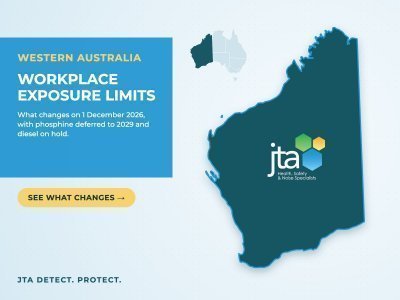
Western Australia adopts Australia's new Workplace Exposure Limits (WELs) on 1 December 2026, including at mine sites. Two substances are held back: the new phosphine limit is deferred to 1 December 2029, and diesel particulate matter is on hold until a regulatory impact assessment is done.
Western Australia at a glance
Victoria and Queensland have given 15 substances a transition to 1 December 2029, and South Australia has delayed four. Western Australia hasn't, apart from phosphine and diesel, so these new limits start in WA on 1 December 2026:
| Substance | Current standard (WES) | From 1 Dec 2026 in WA (WEL) | Where it matters in WA |
|---|---|---|---|
| Manganese fume, dust and compounds | 1 mg/m³ TWA (fume also 3 mg/m³ STEL) | 0.1 mg/m³ (inhalable) and 0.02 mg/m³ (respirable) TWA | Manganese mining and processing, welding |
| Nitric oxide | 25 ppm TWA | 2 ppm TWA | Blasting, diesel equipment underground |
| Sulphur dioxide | 2 ppm TWA, 5 ppm STEL | 0.25 ppm STEL | Smelters and ore processing |
| Nickel metal, powder and sulphide roasting | 1 mg/m³ TWA | 0.1 mg/m³ TWA (metal and insoluble compounds) | Nickel mining, refining and processing |
| Grain dust (oats, wheat, barley) | 4 mg/m³ TWA | 1.5 mg/m³ TWA | Grain receival, storage and export |
| Flour (cereal) dust | No standard | 0.5 mg/m³ TWA | Flour milling, baking and food manufacturing |
| Methyl bromide | 5 ppm TWA | 1 ppm TWA | Fumigation and quarantine |
| Portland cement | 10 mg/m³ TWA (inhalable) | 1 mg/m³ TWA (respirable) | Construction and concrete products |
| Bitumen fumes | 5 mg/m³ TWA | 0.5 mg/m³ TWA | Road surfacing and roofing |
Current values come from Safe Work Australia's WES list and new values from the national WEL list. Check the lists for notations such as skin absorption or sensitisation.
On 14 October 2026 the WA Government gave the new phosphine limit a three-year extension, to 1 December 2029. The eight-hour limit will fall from 0.3 ppm to 0.05 ppm. The extra time is for the grains industry to work through measurement, monitoring and compliance issues, and for product labels to be updated.
Two points from the announcement are worth noting:
Read the WA Government’s phosphine announcement.
WorkSafe WA says a regulatory impact assessment will be done before any change to diesel particulate matter standards or limits in Western Australia. Until then, the new national limit of 0.01 mg/m³ (as respirable elemental carbon) doesn't apply in WA, and no date has been set.
That doesn't make diesel exhaust a low priority. You still have to manage the risk from airborne contaminants that have no limit, and diesel exhaust is a common exposure in mining, transport, warehousing and construction. See Diesel Exhaust Has a New Workplace Exposure Limit in Australia.
Some new limits are so low that current sampling and analysis may not be able to measure them. WorkSafe WA's guidance for these substances, and for the 33 carcinogens with no limit:
WorkSafe WA has published a statement of regulatory intent for the implementation period, 1 December 2026 to 30 November 2027. It says that during this period:
This isn't a 12-month grace period. The new limits apply from 1 December 2026, and your duty to control exposure applies now. What changes is how WorkSafe WA responds while businesses adjust.
The new limits apply to mine sites from 1 December 2026. WorkSafe WA points to dust (including silica, asbestos, lead, arsenic and manganese from some ore bodies), chemicals used in explosives and ore processing, and gases from blasting, welding and smelters. Its five steps for mine operators:
| Step | What WorkSafe WA expects |
|---|---|
| 1. Identify | List the airborne contaminants used or generated on site, check each against the WEL list and review existing sample data. |
| 2. Assess | Carry out air monitoring if required, compare results with the new limits and update risk assessments. |
| 3. Control | Apply the hierarchy of controls where results exceed a limit. |
| 4. Document | Update health management plans, the sampling schedule and compliance records such as fit testing, health monitoring and training. Inspectors may ask for these. |
| 5. Review | Keep checking controls work, and watch for updated guidance. |
Read WorkSafe WA’s guidance for mines.
| Substance | Western Australia | NSW | Victoria and Queensland | South Australia |
|---|---|---|---|---|
| Phosphine | 0.05 ppm from 1 Dec 2029 | 0.3 ppm until 30 Jun 2028, then 0.05 ppm | 0.3 ppm until 1 Dec 2029, then 0.05 ppm | 0.05 ppm from July 2028 |
| Diesel particulate matter | On hold pending a regulatory impact assessment | 0.05 mg/m³ until 30 Jun 2028, then 0.01 mg/m³ | 0.1 mg/m³ until 1 Dec 2029, then 0.01 mg/m³ (Victorian underground mining stays at 0.1) | 0.01 mg/m³ from 1 Dec 2026 |
| Manganese | New limits from 1 Dec 2026 | New limits from 1 Dec 2026 | 1 mg/m³ until 1 Dec 2029, then the new limits | New limits from 1 Dec 2026 |
| Grain dust | 1.5 mg/m³ from 1 Dec 2026 | 1.5 mg/m³ from 1 Dec 2026 | 4 mg/m³ until 1 Dec 2029, then 1.5 mg/m³ | 1.5 mg/m³ no earlier than July 2028 |
| Flour dust | 0.5 mg/m³ from 1 Dec 2026 | 0.5 mg/m³ from 1 Dec 2026 | No limit until 1 Dec 2029, then 0.5 mg/m³ | 0.5 mg/m³ no earlier than July 2028 |
For every state and territory, see Workplace Exposure Limits 2026: Dates by State and Territory. Our state guides cover NSW, Victoria, Queensland and South Australia in more detail.
| Step | Action | What to Do |
|---|---|---|
| 1 | List your substances | Include process-generated dusts, fumes and gases, not just purchased chemicals, and check each against the WEL list. |
| 2 | Check the ones that start sooner in WA | Manganese, nitric oxide, sulphur dioxide, nickel, grain and flour dust and others start on 1 December 2026, unlike in the eastern states. |
| 3 | Compare exposure with the new limits | Use recent, representative monitoring. Where results are old or limited, collect more. |
| 4 | Plan for phosphine and diesel | Use the time before 1 December 2029 to sort out phosphine measurement, and keep managing diesel exhaust in the meantime. |
| 5 | Review health monitoring | Check arrangements still suit your substances and exposures, including biological monitoring where it helps. |
| 6 | Keep records | Document monitoring, controls and decisions. WorkSafe WA inspectors may ask for them. |
Not sure where to start? Our free online screener walks you through the substances and tasks at your site.
Check which WEL changes affect you →
| Service | How It Helps | Learn More |
|---|---|---|
| Occupational Hygiene | Identify, assess and manage airborne contaminants against the limits that apply at each site. | View service → |
| Air Monitoring | Measure contaminants in workers' breathing zones so you can compare exposure with the limit. | View service → |
| Health Risk Assessments | Prioritise which substances and tasks need attention first. | View service → |
| Respirator Fit Testing | Make sure tight-fitting respirators protect the workers who rely on them. | View service → |
JTA has an office in Perth. Our occupational hygienists can review your substances against the limits that apply in Western Australia, carry out personal air and dust monitoring and recommend practical controls before the dates that matter to you.
DETECT. PROTECT.
Talk to JTA about a WEL gap assessment.
1300 856 282
More WEL guidance: Workplace Exposure Limits Resource Centre · Workplace Exposure Limits Are Changing · The 33 Carcinogens With No Exposure Limit
Checked on 26 November 2026.
Get a Quote/Book Online
OR
Call Us on 1300 856 282





Head Office Melboune
139 Ormond Road Elwood, VIC 3184
Mornington Peninsula
20 Lister Avenue,
Sorrento,
VIC 3943
JTA Health, Safety & Noise Specialists acknowledges the Boon Wurrung People of the Kulin Nation as the Traditional Owners and Custodians of the land on which the home of JTA resides. We pay our respects to their Elders past, present and emerging, and acknowledge and uphold their continuing relationship to this land.