Your shopping cart is empty.
16
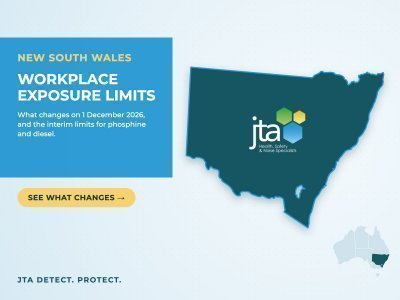
New South Wales adopts Australia's new Workplace Exposure Limits (WELs) on 1 December 2026. Unlike Victoria and Queensland, NSW is not delaying flour dust, grain dust or most other new limits. Instead, it has set interim limits for just two substances, phosphine and diesel particulate matter, until 30 June 2028.
NSW at a glance
For businesses that also operate in Victoria or Queensland, NSW applies the new limits for substances such as flour, grain and softwood dust three years earlier than those states. That makes NSW sites a sensible place to start a national WEL program. See how NSW compares below.
The Work Health and Safety Amendment (Harmonisation) Regulation 2026 amends the NSW Work Health and Safety Regulation 2025. SafeWork NSW says it adopts, with minor changes, the national model provisions on workplace exposure limits, and it commences on 1 December 2026.
From that date, the WHS Regulation refers to Safe Work Australia's Workplace exposure limits for airborne contaminants as in force from time to time. Your core duties don't change: you must make sure no one is exposed above a limit, and carry out air monitoring when you aren't certain, on reasonable grounds, whether exposure exceeds a limit.
The same regulation also makes a handful of unrelated changes, including to PPE duties, high-risk work licence refusals and asbestos sample analysis. They are outside the scope of this article.
NSW has given industry extra time for two substances where the national limits fall sharply:
| Substance | In NSW until 30 June 2028 | From 1 July 2028 (national WEL) |
|---|---|---|
| Phosphine | 0.3 ppm TWA and 1 ppm STEL (the current standard) | 0.05 ppm TWA, with a lower short-term limit |
| Diesel particulate matter (as respirable elemental carbon) | 0.05 mg/m³ TWA | 0.01 mg/m³ TWA |
SafeWork NSW announced the phosphine delay on 29 October 2026 after consulting grain producers, citing the upcoming harvest and practical issues with measurement, biosecurity and export requirements. The interim diesel limit commences on 1 December 2026.
Check older material. Some SafeWork NSW material, including its 27 October 2026 webinar, was published before the interim diesel limit was announced. From 1 December 2026, the diesel limit in NSW is 0.05 mg/m³, not 0.01 mg/m³.
For a site-by-site view of diesel limits across Australia, see Diesel Exhaust Has a New Workplace Exposure Limit in Australia.
Apart from phosphine and diesel, the national WEL list applies in full. These are some of the changes most likely to affect NSW workplaces:
| Substance | Current standard (8-hour TWA) | NSW from 1 December 2026 |
|---|---|---|
| Flour (cereal) dust | No specific limit | 0.5 mg/m³ |
| Grain dust (oats, wheat, barley) | 4 mg/m³ | 1.5 mg/m³ |
| Wood dust (softwood) | 5 mg/m³ (plus 10 mg/m³ STEL) | 2 mg/m³ |
| Portland cement | 10 mg/m³ (inhalable) | 1 mg/m³ (respirable) |
| Bitumen fumes | 5 mg/m³ | 0.5 mg/m³ |
| Styrene, monomer | 50 ppm | 20 ppm |
| Perchloroethylene | 50 ppm | 20 ppm |
| Nitric oxide | 25 ppm | 2 ppm |
| Methyl bromide | 5 ppm | 1 ppm |
| Manganese fume, dust and compounds | 1 mg/m³ | 0.1 mg/m³ (inhalable) and 0.02 mg/m³ (respirable) |
| Nickel, metal and insoluble compounds | 1 mg/m³ (metal, powder, sulphide roasting) | 0.1 mg/m³ |
Several substances also gain new or changed short-term limits. Portland cement moves to a respirable measure and manganese adds one, so older inhalable results can't be compared directly with the new numbers. Check the full WEL list for every substance you use or generate.
These are the same substances that Victoria and Queensland have placed on a three-year transition. In NSW they apply from 1 December 2026.
Across the national list:
The silica limit stays at 0.05 mg/m³ (8-hour TWA) on 1 December 2026, but NSW's silica rules still apply in full:
NSW mines and petroleum sites also have mining-specific WHS laws and are regulated by the NSW Resources Regulator. Its current diesel particulate matter standard for mines is 0.1 mg/m³, in place since February 2021, and the Mine Safety Advisory Council has recommended a separate, more practicable diesel limit for coal and underground metalliferous mines.
When we checked, the final mining arrangements for diesel had not been published. If you operate a mine or quarry, confirm the position with the Resources Regulator before relying on the figures above.
If you run sites in more than one state, the same task can face different limits depending on the site:
| Substance | NSW | Victoria | Queensland |
|---|---|---|---|
| Flour dust | 0.5 mg/m³ from 1 Dec 2026 | No limit until 1 Dec 2029, then 0.5 mg/m³ | No limit until 1 Dec 2029, then 0.5 mg/m³ |
| Grain dust | 1.5 mg/m³ from 1 Dec 2026 | 4 mg/m³ until 1 Dec 2029, then 1.5 mg/m³ | 4 mg/m³ until 1 Dec 2029, then 1.5 mg/m³ |
| Softwood dust | 2 mg/m³ from 1 Dec 2026 | 5 mg/m³ until 1 Dec 2029, then 2 mg/m³ | 5 mg/m³ until 1 Dec 2029, then 2 mg/m³ |
| Diesel particulate matter | 0.05 mg/m³ until 30 Jun 2028, then 0.01 mg/m³ | 0.1 mg/m³ until 1 Dec 2029, then 0.01 mg/m³ (underground mining stays at 0.1) | 0.1 mg/m³ until 1 Dec 2029, then 0.01 mg/m³ |
| Phosphine | 0.3 ppm until 30 Jun 2028, then 0.05 ppm | 0.3 ppm until 1 Dec 2029, then 0.05 ppm | 0.3 ppm until 1 Dec 2029, then 0.05 ppm |
| Portland cement | 1 mg/m³ (respirable) from 1 Dec 2026 | 10 mg/m³ (inhalable) until 1 Dec 2029, then 1 mg/m³ respirable | 10 mg/m³ (inhalable) until 1 Dec 2029, then 1 mg/m³ respirable |
For every state and territory, see our state-by-state flour dust table, and for Victoria's 15 transitional substances, see Which Workplace Exposure Limits Are Delayed in Victoria? and Workplace Exposure Limits in Queensland.
1 December 2026 is close, so prioritise the substances where the limit is new or falls the most.
| Step | Action | What to Do |
|---|---|---|
| 1 | List your airborne contaminants | Include materials you buy and the dusts, fumes and gases your processes generate, such as flour, grain, timber, cement and welding fume. |
| 2 | Compare with the WEL list | Flag substances with a new limit, a lower limit or a changed measurement basis such as respirable dust. |
| 3 | Review your monitoring data | Only personal breathing-zone results can be compared with a limit. Treat older, limited or inhalable-only results as a gap. |
| 4 | Review controls | Follow the hierarchy of controls. Respiratory protection should not be the only control where higher-order controls are reasonably practicable. |
| 5 | Plan for July 2028 | If you use phosphine or run diesel equipment, plan now for the national limits that start on 1 July 2028. |
| 6 | Check health monitoring | Confirm health monitoring arrangements still suit the substances and exposures at each site. |
| Service | How It Helps | Learn More |
|---|---|---|
| Occupational Hygiene | Identify, assess and manage airborne contaminants against the limits that apply at each site. | View service → |
| Air Monitoring | Measure contaminants in workers' breathing zones so you can compare exposure with the limit. | View service → |
| Health Risk Assessments | Prioritise which substances and tasks need attention first. | View service → |
| Respirator Fit Testing | Make sure tight-fitting respirators protect the workers who rely on them. | View service → |
JTA's occupational hygienists can review your substances against the limits that apply in NSW, carry out personal air monitoring and recommend practical controls before the dates that matter to you.
DETECT. PROTECT.
Talk to JTA about a WEL gap assessment.
1300 856 282
More WEL guidance: Workplace Exposure Limits Resource Centre · Workplace Exposure Limits Are Changing · Flour Dust Now Has a Legal Limit
Checked on 12 November 2026.
Get a Quote/Book Online
OR
Call Us on 1300 856 282





Head Office Melboune
139 Ormond Road Elwood, VIC 3184
Mornington Peninsula
20 Lister Avenue,
Sorrento,
VIC 3943
JTA Health, Safety & Noise Specialists acknowledges the Boon Wurrung People of the Kulin Nation as the Traditional Owners and Custodians of the land on which the home of JTA resides. We pay our respects to their Elders past, present and emerging, and acknowledge and uphold their continuing relationship to this land.