Your shopping cart is empty.
16
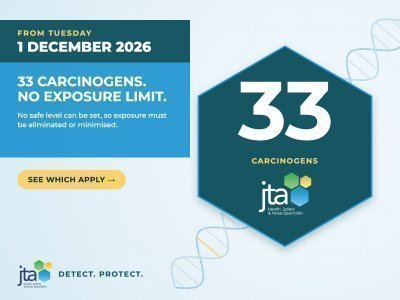
From 1 December 2026, 33 chemicals known as non-threshold genotoxic carcinogens (NTGCs) come off Australia’s workplace exposure list. They lose their exposure standard and won’t get a new limit, because no safe level of exposure can be set. That doesn’t relax the rules. It removes the pass mark.
Non-threshold genotoxic carcinogens at a glance
On this page: What NTGCs are · Click your task · The full list of 33 · What “no limit” means · What to do now · Quick quiz · FAQ
Genotoxic chemicals can damage the genetic material in cells, which can lead to cancer. Non-threshold means there is no level of exposure below which the risk disappears. Even small exposures add to the risk.
Safe Work Australia’s review of the workplace exposure standards found 33 airborne contaminants that fit this description. Because no practical safe level can be set, they are moving off the workplace exposure limits list and onto a separate list, with no numerical limit.
Many of the 33 are rarely used outside chemical plants. A few turn up in everyday work, sometimes created by the task itself rather than bought in a drum. Click a task to see which carcinogen it involves and what to check.
Carcinogen at risk: Chromium VI (hexavalent chromium)
How exposure happens: Stainless steel contains chromium. The heat of welding, plasma cutting and grinding turns some of it into chromium VI in the fume.
What to check: Fume extraction at the arc or cutting point, process choice, and whether welders on stainless work have been monitored. The current standard of 0.05 mg/m³ goes on 1 December, with no new limit.
Carcinogen at risk: Chromium VI compounds, including zinc chromates
How exposure happens: Mist from chrome plating baths, and spraying, sanding or removing chromate-based primers and coatings.
What to check: Whether chromate-free products are available, tank ventilation and covers, and controls for spray painting and surface preparation.
Carcinogen at risk: Lead chromate
How exposure happens: Older yellow and orange paints, including some road markings and machinery coatings, used lead chromate pigment. Dry sanding, grinding or abrasive blasting puts it in the air.
What to check: Test old paint before removing it, prefer wet or enclosed methods, and remember lead itself still has its own limit of 0.05 mg/m³.
Carcinogen at risk: Coal tar pitch volatiles, and PAH mixtures containing benzo[a]pyrene
How exposure happens: Milling or removing old coal-tar road surfaces, and older coal-tar roofing and waterproofing products.
What to check: Whether old surfaces contain coal tar before milling, dust and fume controls on plant, and skin protection. Modern bitumen is different: bitumen fume has its own new limit of 0.5 mg/m³.
Carcinogen at risk: Chromium VI (CCA treatment solutions) and PAH mixtures containing benzo[a]pyrene (creosote)
How exposure happens: Mixing and handling CCA treatment chemicals, and working with creosote or freshly treated timber.
What to check: Closed transfer of treatment chemicals, ventilation in treatment areas, and skin and respiratory protection.
Carcinogen at risk: Ethylene oxide
How exposure happens: Leaks and off-gassing from ethylene oxide sterilisers, and handling freshly sterilised loads before aeration is complete.
What to check: Steriliser maintenance, aeration times, room ventilation and leak detection.
Carcinogen at risk: 1,3-Butadiene, vinyl chloride, acrylonitrile, beta-chloroprene and ethylene dichloride
How exposure happens: Producing synthetic rubber, PVC, ABS, nitrile and neoprene, where the raw monomers are handled or released from process equipment.
What to check: Leak detection, closed systems, and exposure during maintenance, sampling and cleaning.
Carcinogen at risk: MOCA (4,4′-methylene bis(2-chloroaniline)) and allyl glycidyl ether
How exposure happens: MOCA is a curing agent for cast polyurethane products such as rollers and wheels. Allyl glycidyl ether is used in some epoxy resins and adhesives.
What to check: Alternative curing agents and resins, enclosed melting and mixing, and skin protection, since both can be absorbed through the skin.
Carcinogen at risk: Hydrazine and acrylamide
How exposure happens: Hydrazine is used as an oxygen scavenger in some boiler water treatment. Acrylamide is used to make water-treatment polymers and in some chemical grouts for tunnels, dams and sewers.
What to check: Whether safer treatment chemicals are available, closed dosing systems, and controls when mixing grouts.
Carcinogen at risk: 1,2-Dibromoethane (ethylene dibromide)
How exposure happens: Ethylene dibromide is added to leaded aviation gasoline (avgas). Exposure comes from refuelling, tank and fuel-system maintenance, and spills.
What to check: Vapour exposure during fuelling and tank entry, ventilation in hangars and workshops, and skin contact with fuel.
Carcinogen at risk: Coal tar pitch volatiles and PAH mixtures containing benzo[a]pyrene
How exposure happens: Pitch-based anodes and electrodes, coke production, and some foundry processes release PAH-rich fume.
What to check: Enclosure and extraction at the source, and exposure during maintenance and cleaning.
Carcinogen at risk: Most of the rest of the 33, including the anisidines, benzidine, 3,3′-dichlorobenzidine, dimethyl and diethyl sulfate, and urethane
How exposure happens: These are mainly intermediates and reagents used in making dyes, pigments, pharmaceuticals and other chemicals, or in laboratory work.
What to check: Your chemical register and safety data sheets, closed handling, and fume cupboard performance. Benzidine and bis(chloromethyl) ether are already prohibited carcinogens under the WHS Regulations, apart from genuine research and analysis.
Want the full picture for your site? JTA’s online WEL check covers every substance on the list, including these 33. Select the activities at your workplace, answer a few short questions and download a report showing the current standard and the new limit for each substance. It takes 3–5 minutes.
Not sure whether a task at your site involves one of these? JTA’s occupational hygienists can help you work it out.
These are the 33 chemicals that lose their workplace exposure standard on 1 December 2026, with examples of where each is typically found at work.
| Chemical | Where it’s typically found at work |
|---|---|
| Acrylamide | Making water-treatment and paper polymers, some chemical grouts, laboratories |
| Acrylonitrile (vinyl cyanide) | Making acrylic fibres, ABS plastic and nitrile rubber |
| Allyl chloride | Chemical manufacturing, including epoxy resin raw materials |
| Allyl glycidyl ether | Some epoxy resins, adhesives and coatings |
| Anisidine (o-, p- isomers) | Dye and pigment manufacturing |
| o-Anisidine | Dye and pigment manufacturing |
| p-Anisidine | Dye and pigment manufacturing |
| Benzidine | Historically dye manufacturing; now a prohibited carcinogen except for research and analysis |
| bis(Chloromethyl) ether | Chemical intermediate and impurity; a prohibited carcinogen except for research and analysis |
| 1,3-Butadiene | Making synthetic rubber and plastics; petrochemical plants |
| Catechol | Chemical manufacturing, photographic developers and dyes |
| beta-Chloroprene | Making neoprene (polychloroprene) rubber |
| Chromium VI compounds (including zinc chromates) | Welding and cutting stainless steel, chrome plating, chromate primers, CCA timber treatment |
| Coal tar pitch volatiles | Old coal-tar road surfaces and roofing, aluminium smelting, coke ovens, electrodes |
| 1,2-Dibromoethane (ethylene dibromide) | Leaded aviation gasoline (avgas); formerly a fumigant |
| 3,3′-Dichlorobenzidine | Pigment manufacturing |
| Diethyl sulfate | Chemical and pharmaceutical manufacturing |
| Dimethylcarbamoyl chloride | Chemical and pharmaceutical manufacturing |
| Dimethyl sulfate | Chemical and pharmaceutical manufacturing |
| Dinitrotoluene | Making toluene diisocyanate (TDI) for polyurethanes; explosives and propellants |
| Ethylene dichloride (1,2-dichloroethane) | Making vinyl chloride for PVC; solvent |
| Ethylene oxide | Sterilising medical equipment; making glycols and surfactants |
| Ethylenimine (aziridine) | Chemical and polymer manufacturing |
| Hydrazine | Boiler water treatment, chemical manufacturing |
| Lead chromate | Old yellow and orange paints, including some road markings |
| MOCA (4,4′-methylene bis(2-chloroaniline)) | Curing agent for cast polyurethane products |
| 2-Nitrotoluene | Dye, rubber-chemical and agricultural-chemical manufacturing |
| Propane sultone | Chemical manufacturing; some lithium-ion battery electrolytes |
| PAH mixtures containing benzo[a]pyrene | Coal tar, creosote, soot and combustion products, coke ovens |
| Tetranitromethane | Chemical manufacturing and laboratories; propellants |
| Urethane (ethyl carbamate) | Chemical manufacturing and laboratories |
| Vinyl bromide | Chemical manufacturing, including flame retardants |
| Vinyl chloride monomer | Making PVC |
Until 30 November 2026, these chemicals have workplace exposure standards. Chromium VI, for example, has a standard of 0.05 mg/m³. If monitoring showed exposure under the number, that largely answered the question.
From 1 December, there is no number. Instead, you must:
In practice, that means the question changes from “are we under the limit?” to “have we done everything reasonably practicable, and can we show it?” Lower exposure is always better, and the records you keep matter more than before.
| Step | Action | What to Do |
|---|---|---|
| 1 | Check your chemical register | Search your register and safety data sheets for the 33 names. Hazard statements such as H340 (may cause genetic defects) and H350 (may cause cancer) are a useful flag. |
| 2 | Find the tasks that generate them | Some of the 33 are created by the work, not bought in, such as chromium VI from welding stainless steel. Use the task list above. |
| 3 | Eliminate or substitute | Ask whether you can stop using the chemical or switch to a safer product, such as chromate-free primers. |
| 4 | Control what remains | Follow the hierarchy of controls: enclosure and local exhaust ventilation first, then work practices, then fit-tested respiratory protection. |
| 5 | Check the controls work | Personal air monitoring before and after changes shows whether exposure has actually come down. |
| 6 | Record your decisions | Keep a record of what you considered, what you changed and why, so you can show exposure is as low as reasonably practicable. |
JTA’s Tom and Narah answer common questions about the move to Workplace Exposure Limits.
Some well-known hazards are not among the 33. Click each question to check your answer.
No. General welding fume has a limit of 1 mg/m³. But welding stainless steel produces chromium VI, which is on the list.
No. Respirable crystalline silica keeps its 0.05 mg/m³ limit on 1 December.
No. Benzene is one of nine chemicals that keep their current value on 1 December. It drops to 0.2 ppm on 1 June 2027.
No. Diesel particulate matter gets a new limit of 0.01 mg/m³, with interim limits in NSW, Victoria and Queensland.
No. Formaldehyde is one of the nine chemicals that keep their current values for now.
No. Chromium metal and chromium (II) and (III) compounds have a limit of 0.5 mg/m³. Only chromium VI compounds are on the list.
Yes. From 1 December it has no exposure limit, and exposure must be eliminated or minimised.
Yes. None of the delays announced by the states covers these 33 chemicals, so they lose their exposure standards on 1 December. Mines can be covered by separate mining laws, so check with your mining regulator. See JTA’s dates for every state and territory for the substances that are delayed.
WorkSafe Queensland notes there is no mandatory requirement to conduct air monitoring for these chemicals, because there is no limit to compare against. Monitoring is still one of the best ways to find high-exposure tasks, check that controls work, and show that exposure is as low as reasonably practicable.
Not necessarily. Being under the old standard used to settle the question. From 1 December, the test is whether you have eliminated the chemical, or reduced exposure as far as reasonably practicable.
Health monitoring duties for listed hazardous chemicals, such as inorganic chromium, vinyl chloride, MOCA and PAHs, are separate and continue to apply.
Yes. Six pesticides that are already prohibited in Australia also come off: aldrin, chlordane, DDT, dieldrin, endrin and heptachlor.
| Service | How It Helps | Learn More |
|---|---|---|
| Occupational Hygiene | Identify where these chemicals are used or generated at your sites, and how workers are exposed. | View service → |
| Air Monitoring | Measure exposure in workers’ breathing zones before and after controls change. | View service → |
| Health Risk Assessments | Prioritise the tasks and chemicals that need attention first. | View service → |
| Respirator Fit Testing | Make sure tight-fitting respirators protect the workers who rely on them. | View service → |
JTA’s occupational hygienists can identify where these chemicals are used or generated, measure exposure, and recommend practical controls before and after 1 December.
DETECT. PROTECT.
Talk to JTA about your carcinogen exposures.
1300 856 282
More WEL guidance: Workplace Exposure Limits Resource Centre · Dates by State and Territory · 31 New Chemicals Added to the Workplace Exposure Limits
Checked on 26 November 2026.
Get a Quote/Book Online
OR
Call Us on 1300 856 282





Head Office Melboune
139 Ormond Road Elwood, VIC 3184
Mornington Peninsula
20 Lister Avenue,
Sorrento,
VIC 3943
JTA Health, Safety & Noise Specialists acknowledges the Boon Wurrung People of the Kulin Nation as the Traditional Owners and Custodians of the land on which the home of JTA resides. We pay our respects to their Elders past, present and emerging, and acknowledge and uphold their continuing relationship to this land.